From Ideas to Institutions: Key Lessons from the Meridian Guild’s Action Lab on Execution
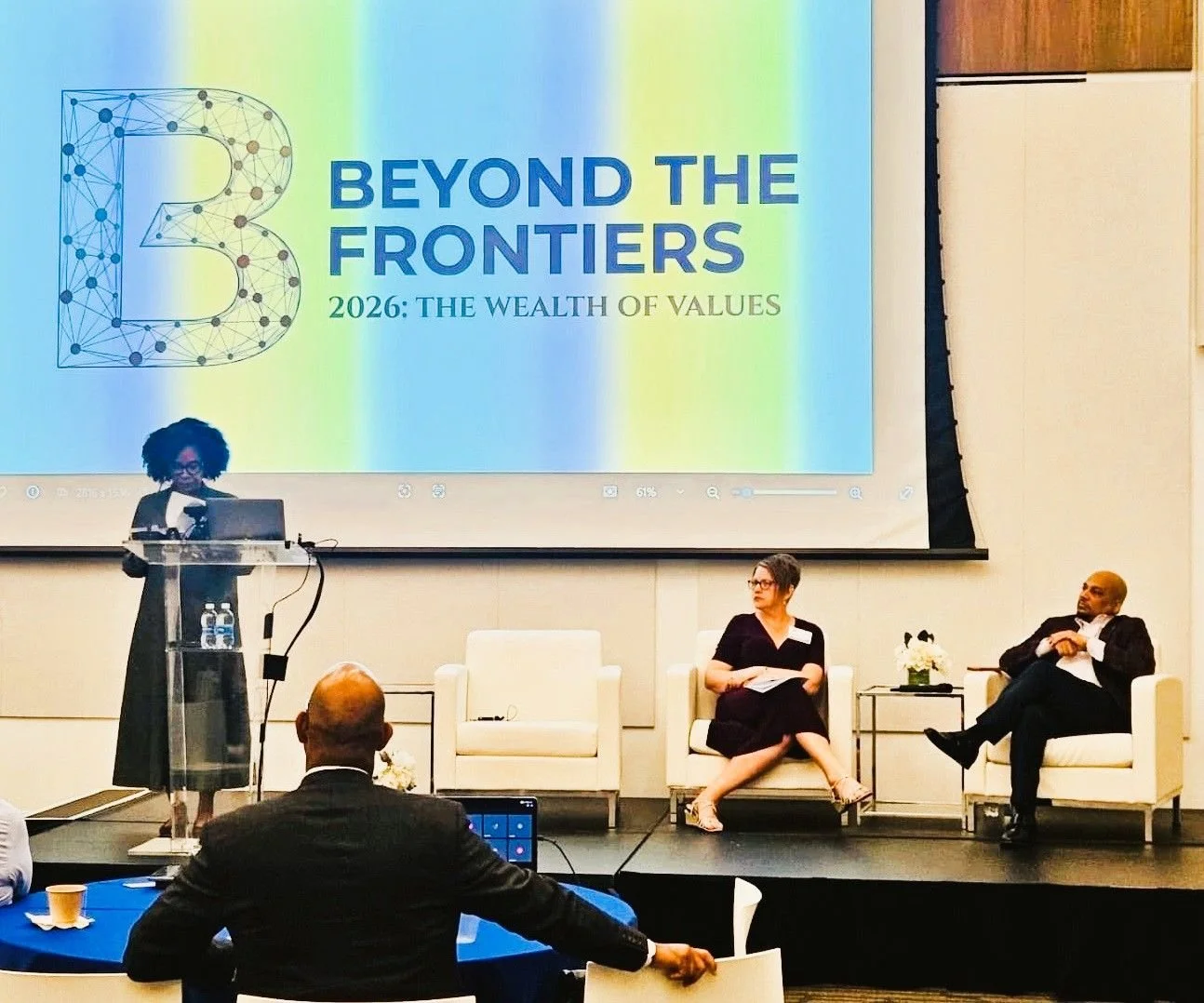
The Meridian Guild at Beyond the Frontiers 2026: The Wealth of Values conference, piloted the Action Lab on Execution, with the execution readiness framework developed and facilitated by Renée Jones, the Founder and CEO of Red Hills Consulting Group. Ms. Renée Jones challenged participants to confront a difficult but essential question:
What does it actually take to move an idea into a durable institution?
Rather than celebrating vision alone, the session focused on the structural realities that determine whether ambitious initiatives can endure. Across two distinct cases, participants examined how governance, decision-making, operating systems, accountability, and capital readiness shape the path from concept to implementation.
The central lesson was clear: initiatives rarely stall because they lack ambition. They stall because the structure required to carry them forward arrives too late.
Opening Remarks: Execution Begins with Structure
In her opening remarks, Renée Jones grounded the session in both personal reflection and institutional insight. Standing on the campus of American University, where her late father had once studied, she reflected on the enduring power of education, discipline, and intergenerational possibility.
But she also drew a distinction that shaped the entire session:
Education creates possibility. Structure is what allows that possibility to endure.
Jones explained that the Action Lab was not designed to generate new ideas, expand projects, or allocate funding. Its purpose was more disciplined: to pressure-test whether existing initiatives were structurally prepared for meaningful progress over the next three to twelve months.
The Meridian Guild framed the conversation around four structural dimensions:
Governance clarity – Who owns the next critical decision?
Ownership and accountability – Is responsibility codified or diffused?
Operating readiness – Are systems and reporting structures in place to scale?
Capital and complexity – Could the structure absorb growth without breaking?
These are not administrative details. They are the conditions that allow momentum to compound.
Case One: Her Arts in Action and the Challenge of Institutionalizing Trust
The first case featured Sarah Drake, CEO of Her Arts in Action, who described an organization built on trust, relationships, storytelling, and lived connection with communities across West Africa.
Drake shared that her work emerged from a deeply personal place. After receiving cancer care that made her aware of the privileges she had access to, she committed herself to building something meaningful with and for underserved communities. Through art, education, and relationship-based partnerships, her work has helped more than 150,000 people gain access to clean water, sanitation, and education.
Yet her central challenge was not impact. It was structure.
Everything, she explained, still largely runs through her. The organization is deeply relational, but also heavily founder-dependent, unpaid, and informal in many respects. The question she brought to the Action Lab was direct:
How do you translate trust, partnerships, and relationships into formal systems that allow an organization to grow and endure beyond the founder?
Through the facilitated discussion, several execution risks surfaced:
A founder-centered operating model
Unclear governance and decision rights across the U.S. and West African contexts
A gap between funder expectations and current governance capacity
What became especially clear was that the organization’s greatest asset, trust, was also its greatest scaling vulnerability. Drake emphasized that because she works in communities that are not her own, trust must remain central. She has intentionally grown slowly in order to preserve authenticity and protect the voices of the women and girls her work serves.
Audience reflections reinforced that the issue was not mission clarity but operationalization. Participants pointed to the need for stronger board engagement, documented operating procedures, structured fundraising, and dedicated roles for communications, partnerships, and program execution.
In summarizing the case, Jones identified three immediate priorities:
Define and document decision rights
Establish a governance structure appropriate for capital flows
Build a minimum replicable operating system
The challenge, she noted, is not to replace trust with bureaucracy, but to institutionalize the work without losing the trust that made the mission possible in the first place.
Case Two: The National Business League and AI-Enabled Institutional Infrastructure
The second case featured Dr. Kenneth Harris, CEO of the National Business League, and focused on how a long-standing institution can transition from traditional administration into an AI-enabled organizational platform.
Harris described an institution with a national board, administrative staff, regional offices, a headquarters in Tuskegee, and a local chapter structure spanning all 50 states. Because the organization controls its infrastructure nationally, he argued, it has a unique opportunity to modernize in ways that many historic institutions cannot.
The vision is ambitious: a national AI-powered platform that would register businesses, certify readiness, track supplier development, connect firms to procurement opportunities, and support local chapters with real-time data, automation, and administrative tools. In this model, local chapter leaders would no longer be crushed by volunteer administrative burdens; instead, AI-driven systems would enable them to focus on local economic development.
The concept also extends globally, connecting local businesses not only within the United States but also across diaspora and international networks, including the Caribbean and Africa.
But as with the first case, the Action Lab was not evaluating the vision. It was evaluating the structure required to deploy it.
The diagnostic discussion identified several core issues:
Technology capacity and cybersecurity as likely first points of failure if demand scaled quickly
The need for a long-range mapping process spanning three, five, seven, and nine years
The importance of human capital alongside technological capacity
The need for governance models that allow the platform to function as institutional infrastructure, not just a promising program
A particularly rich thread in the conversation centered on centralization versus decentralized execution. Harris argued that while the national organization would retain governance authority, local chapters should operate as empowered nodes within a common technological system. This would reduce bureaucracy, improve responsiveness, and shift the institution away from personality-driven operations toward process-driven systems.
Audience members also raised important questions about credibility, transparency, past governance challenges, fit-for-purpose organizational design, and whether some services should be outsourced for greater agility.
By the end of the case discussion, several execution risks stood out:
Platform ambition exceeding operating infrastructure
Unclear governance architecture for national-scale deployment
Technical and data capacity not yet aligned with supplier-scale ambitions
The immediate priorities were equally clear:
Define platform governance and decision authority
Build data and verification infrastructure
Establish the institutional operating model before scaling capital
As Jones noted, the opportunity is enormous, but platform-scale ambition requires infrastructure to be designed before demand spikes.
Cross-Case Synthesis: Different Initiatives, Same Structural Questions
In the final synthesis, Jones stepped back to compare the two cases. On the surface, they were very different. One was a grassroots initiative rooted in trust, storytelling, and social impact. The other was a legacy institution seeking to build a national AI-enabled economic platform.
But underneath those differences, the execution questions were strikingly similar.
In both cases, what initially appeared to be a question of technical capacity turned out to be something deeper:
governance clarity
operating readiness
decision rights
accountability
institutional infrastructure
The session repeatedly returned to the same underlying truth: when ambition grows faster than structure, accountability weakens, systems fracture, and momentum stalls.
Participants reflected on what signals would indicate genuine readiness for scale. Several themes emerged:
A strong, credible board that can steward the vision beyond one individual
Real agreements, contracts, or formalized partnerships already in place
Evidence that operating systems and governance processes are no longer informal
Confidence that the initiative is not only visionary, but institutionally disciplined
Closing Reflection: Structure Determines Whether Ideas Endure
In her closing reflection, Renée Jones returned to the core message of the session:
“The difference between a compelling idea and a lasting institution is whether the structure exists to carry it.”
She reminded participants that governance clarity, decision rights, operating systems, and institutional infrastructure are often mistaken for technical or administrative matters. In reality, they are what determine whether possibility can endure across time.
Her final challenge to the room was simple and powerful:
Do not ask only whether your idea is strong. Ask whether your structure is ready.
Because execution, she concluded, is not simply speed.
Execution is alignment. And alignment is a decision.
Reflections from Participants
The session resonated deeply with the leaders who took part.
Dr. Kenneth Harris reflected: “The Action Lab surfaced a truth many institutions face: promising initiatives often stall where governance, execution systems, and operating capacity are still underbuilt.”
Renée Jones later affirmed the importance of building from that insight: “Governance documents, operating policies, and credible systems are what help strong ideas become durable institutions.”
Sarah Drake described the session as both clarifying and energizing: “The conversation helped me see both what already exists and what now needs to be strengthened for the next phase of growth.”
She added: “The questions on governance clarity and decision ownership stayed with me. They sharpened how I’m thinking about structure, accountability, and long-term sustainability.”
Final Takeaway
The Action Lab did not offer easy answers. It offered something more valuable: a disciplined framework for seeing where promising initiatives become vulnerable as they move toward scale.
That may have been the session’s greatest contribution.
In a world full of ambitious ideas, the question is no longer only who has the boldest vision.
The real question is: who has built the structure that allows the vision to endure?