Emerging Markets Must Move from AI Consumers to AI Creators
Insights from Juan Carlos Lopez Gutierrez, Managing Director – Latin America at EON Reality
At the Beyond the Frontiers 2026: The Wealth of Values Conference, a panel on How Emerging Markets Are Shaping the AI Future explored one of the defining challenges of the artificial intelligence era:
Will emerging markets help build the future of AI, or simply adopt technologies developed elsewhere? The conversation, moderated by Stefanie Falconi, examined the widening gap between countries building advanced AI systems and those still navigating how to access the infrastructure, capital, and technical ecosystems required to participate fully.
According to Juan Carlos Lopez Gutierrez, Managing Director for Latin America at EON Reality, that gap has widened dramatically over the past year.
Most of the world’s advanced AI infrastructure, particularly large foundation models, remains concentrated in a small number of technology hubs in the United States and parts of Europe. Meanwhile, innovators across the Global South are still working to access the resources necessary to build comparable systems.
“The distance between those building AI and the rest of the world is growing,” he observed.
If this trend continues, emerging markets risk becoming long-term consumers of AI technologies rather than creators of them.
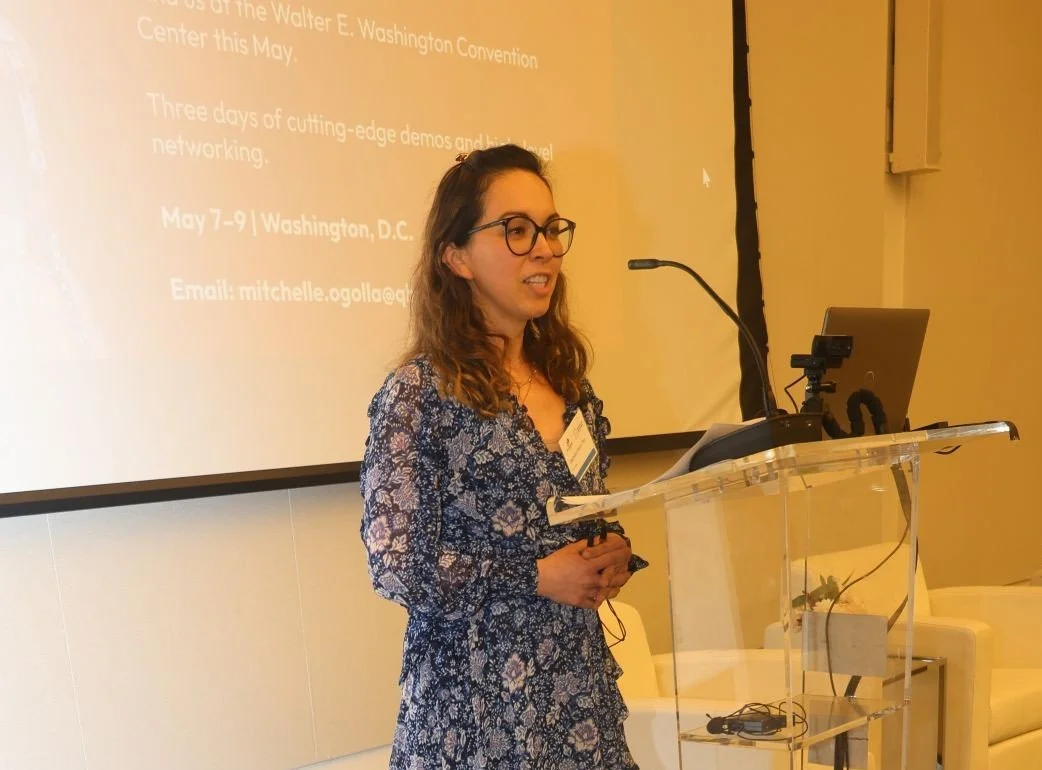



A personal encounter with AI’s acceleration
Gutierrez shared a story that illustrates how quickly the AI landscape has evolved.
About three years ago, shortly before the explosion of generative AI, he met a Swedish technologist working in immersive technologies such as virtual reality (VR), augmented reality (AR), and extended reality (XR).
During a meeting in Colombia, the technologist asked him a simple question:
“Have you seen what OpenAI is doing?” At the time, Gutierrez had not. That same day, OpenAI released ChatGPT. As his colleague began experimenting with the tool, testing its capabilities with engineers and asking it increasingly complex questions, they realized something important. The technology was already powerful enough to deploy in countries like Colombia.
But there was also a deeper realization. Many countries encounter transformative technologies after they have already matured elsewhere. Without strong connections to innovation hubs, emerging markets often learn through consumption rather than creation.
The AI skill shift: from coding to prompting
One of the most profound changes Gutierrez described involves how people interact with technology itself. For decades, digital innovation required programming expertise. But artificial intelligence is beginning to shift the paradigm.
“In the AI era, the critical skill may no longer be coding alone,” he explained.
“Instead, the ability to ask the right questions, through structured prompts, is becoming increasingly valuable. Effective prompting requires more than a simple query. It involves understanding context, defining intent, and knowing the outcome you want to achieve.”
This shift has important implications for accessibility.
Someone who previously lacked formal programming skills can now use AI tools to generate insights, develop ideas, build prototypes, or even launch new ventures. In this sense, AI could become a powerful equalizer.
Bridging linguistic and cultural divides
Another area where AI could have a significant impact is language.
Even within Latin America, Spanish varies widely between countries: Colombian Spanish, Mexican Spanish, and Argentinian Spanish, sometimes complicating collaboration across borders. AI systems capable of translating across linguistic and cultural nuances could help people communicate and cooperate more easily. But this opportunity also highlights the importance of AI sovereignty.
“Countries increasingly recognize the need to build their own data systems, infrastructure, and language models that reflect their own cultures and societies.”
The challenge is that the level of investment required to compete globally is enormous.
Without sustained investment, emerging markets may struggle to develop AI ecosystems that reflect their own needs.
AI beyond chatbots
Gutierrez also emphasized that AI extends far beyond conversational systems like ChatGPT.
Artificial intelligence is increasingly embedded across the digital ecosystem — in images, voice systems, Internet of Things devices, and automated digital interactions.
He described conversational AI tools as just one branch of a much larger technological family. “These tools have brothers, sisters, and cousins,” he noted, referring to the many AI technologies already transforming industries.
Across sectors, organizations are using AI to improve productivity and accelerate knowledge sharing.
Teachers are experimenting with AI-enabled tools to structure and distribute knowledge more effectively. Small and medium-sized enterprises are adopting AI systems that support decision-making and operational efficiency. Governments are deploying AI chatbots to help citizens access services more quickly.
Yet adoption is often happening faster than institutions can adapt.
Infrastructure still matters
Many organizations are integrating AI into their workflows without fully developed systems for data governance, cybersecurity, computing infrastructure, and internal technical capacity.
In many cases, institutions are reacting to AI rather than preparing for it.
Infrastructure gaps remain one of the most significant barriers.
In rural regions and even in some urban areas, the telecommunications networks required to support advanced digital technologies remain limited.
Without reliable connectivity and computing capacity, entire communities risk being excluded from the AI-driven economy.
To address this challenge, some innovators are exploring decentralized technology infrastructure, including community-based servers capable of supporting AI tools locally.
These approaches could create new pathways for regions far from major digital infrastructure hubs.
Building AI ecosystems through collaboration
Mr. Gutierrez also highlighted the importance of collaboration in building sustainable AI ecosystems.
He provided an example of an initiative in Costa Rica that brought together 15 universities to explore how immersive technologies and spatial AI could transform education. Within this program, he said, faculty and students worked together to develop digital learning environments and AI-enabled educational materials. The goal was not simply to adopt technology but to build the capacity to create it.
Mr. Gutierrez also noted another initiative in Panama, which focuses on workforce development linked to the Panama Canal ecosystem, using immersive learning technologies to help workers reskill for increasingly digital industries.
These examples illustrate how ecosystem collaboration, involving universities, industry partners, governments, and social organizations, can accelerate technological development.
The role of community networks
In closing remarks, Gutierrez highlighted encouraging developments across Latin America.
Organizations such as Women in Tech are helping build communities of women working in artificial intelligence and digital transformation. Through seminars, webinars, and collaborative projects, these networks are expanding leadership opportunities and helping address gender disparities in the technology sector.
At the same time, developers across Latin America are working on tools to accelerate the translation and transcription of datasets across languages.
Regular competitions and meetups allow technologists to share progress, improve multilingual AI capabilities, and strengthen cross-country collaboration.
These grassroots initiatives may prove just as important as large investments.
Strong technology ecosystems, Gutierrez emphasized, are often built through communities of practice.
The future of AI must be more distributed
Artificial intelligence offers enormous opportunities for emerging markets.
But realizing that potential will require deliberate investment in infrastructure, education, data governance, and local innovation ecosystems.
If those foundations are built, emerging markets can move from being consumers of AI technologies to active builders of the digital future.